Who Was Odin Allfather: Names, Sacrifices, and Leadership of the Aesir in Norse Mythology
In the vast body of Norse mythology, few figures carry as much weight and complexity as Odin, the Allfather of the gods. Known by dozens of names across different regions and time periods, Odin was far more than the one-eyed wanderer popular culture often portrays. He was a god of wisdom, war, poetry, death, and magic, whose relentless pursuit of knowledge shaped the very foundations of the Nine Worlds. Understanding who Odin Allfather truly was requires looking beyond the single eye and examining his many identities, his legendary sacrifices, and his role as the supreme leader of the Aesir.
The Many Names of Odin
One of the most striking aspects of Odin is the sheer number of names and titles attributed to him in the Old Norse sources. The poem Hávamál, found in the Poetic Edda, contains a section where Odin himself lists nine of his names, but scholars have identified many more throughout the surviving texts. These names were not simply alternative labels; each reflected a different aspect of his nature or a different role he played in the mythological cosmos.
- Óðinn is the Old Norse form of his name, often translated as “the furious” or “the inspired one,” linking him to both battle frenzy and poetic ecstasy.
- Grímnir means “the masked one” or “the hooded one,” referencing his tendency to travel in disguise among mortals and other beings.
- Hár translates to “the high one,” emphasizing his elevated status among the gods.
- Bǫldr means “the bold” or “the strong,” connecting him to martial power.
- Gagnrǫðr means “the victorious counselor,” highlighting his role as a strategic thinker and advisor.
- Viðurr is interpreted as “the widower” or sometimes as “the destroyer,” pointing to his association with death and the battlefield.
- Svipall means “the changeable one,” reflecting his shape-shifting abilities and unpredictable nature.
- Sanngetall translates to “the one who can discover truth,” reinforcing his connection to divination and hidden knowledge.
- Hnikuðr means “the one who stirs up,” often associated with inspiring warriors in battle.
These names, among many others, served practical purposes in the oral tradition. Skalds and storytellers could invoke different aspects of Odin depending on the context of the narrative. A tale of prophecy might call upon Sanngetall, while a story of warfare might invoke Hnikuðr. The multiplicity of names also reflected a deeper theological idea: that the divine could not be reduced to a single identity or function.
Sacrifices for Wisdom
The question of who was Odin Allfather sacrifice for wisdom touches on one of the most powerful and frequently retold elements of his mythology. Odin’s pursuit of knowledge was not casual or academic; it demanded profound personal cost, and the myths describe several distinct acts of self-sacrifice that define his character.
The Eye at Mímir’s Well
Perhaps the most famous sacrifice is the loss of one of Odin’s eyes. According to the account in the Gylfaginning (part of the Prose Edda by Snorri Sturluson), Odin traveled to the well of Mímir, located beneath one of the roots of the world tree Yggdrasil. Mímir, the guardian of the well, required a payment in exchange for a single drink from its waters, which contained cosmic wisdom and understanding. Odin offered one of his eyes, and in return received the ability to see across all the Nine Worlds. This sacrifice left him perpetually one-eyed, but it also granted him a form of perception that no other being possessed.
Hanging on Yggdrasil
An even more dramatic sacrifice is described in Hávamál, where Odin recounts hanging himself on the world tree for nine nights, wounded by a spear, with no food or drink. This ordeal, often called the “shamanic sacrifice” by scholars, lasted nine nights and resulted in Odin discovering the runes — the sacred symbols used for writing, magic, and divination. The passage describes him looking downward and seizing the runes, gaining their secrets through suffering and endurance. This episode connects Odin to broader shamanic traditions found across northern Eurasian cultures, where self-sacrifice and visionary journeys were central to spiritual practice.
The Quest for the Mead of Poetry
A third major sacrifice involved Odin’s pursuit of the Mead of Poetry, a supernatural drink brewed from the blood of the wise being Kvasir. After the mead was stolen by the giant Suttungr, Odin spent years working to reclaim it, eventually transforming into an eagle to drink the mead and fly back to Asgard. While this sacrifice was more about cunning and endurance than physical loss, it demonstrates the lengths to which Odin would go to secure poetic and intellectual power — not just for himself, but for those he deemed worthy of sharing it.
Leader of the Aesir
Odin’s role as the chief of the Aesir — the principal tribe of gods in Norse mythology — was not simply a matter of being the strongest or most powerful. His authority rested on a combination of wisdom, magical knowledge, and strategic thinking that set him apart from the other gods. While Thor wielded his hammer with unmatched force and Tyr sacrificed his hand to maintain cosmic order, Odin governed through insight and foresight.
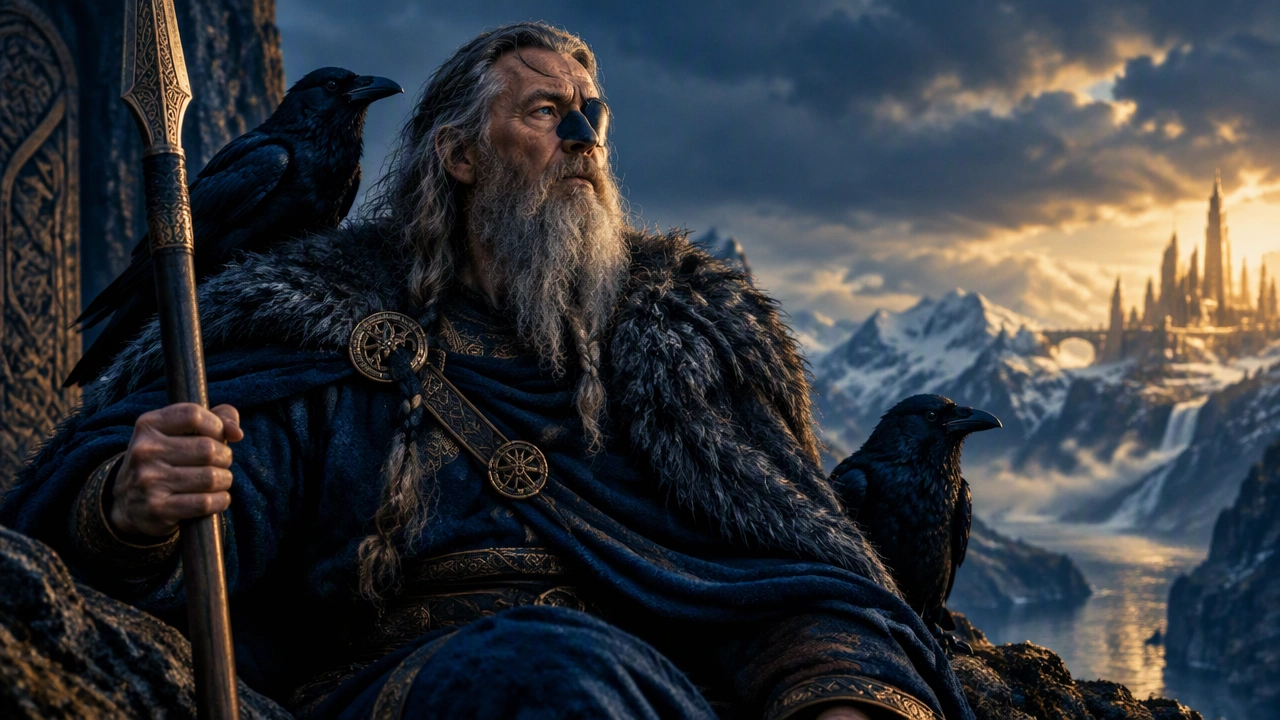
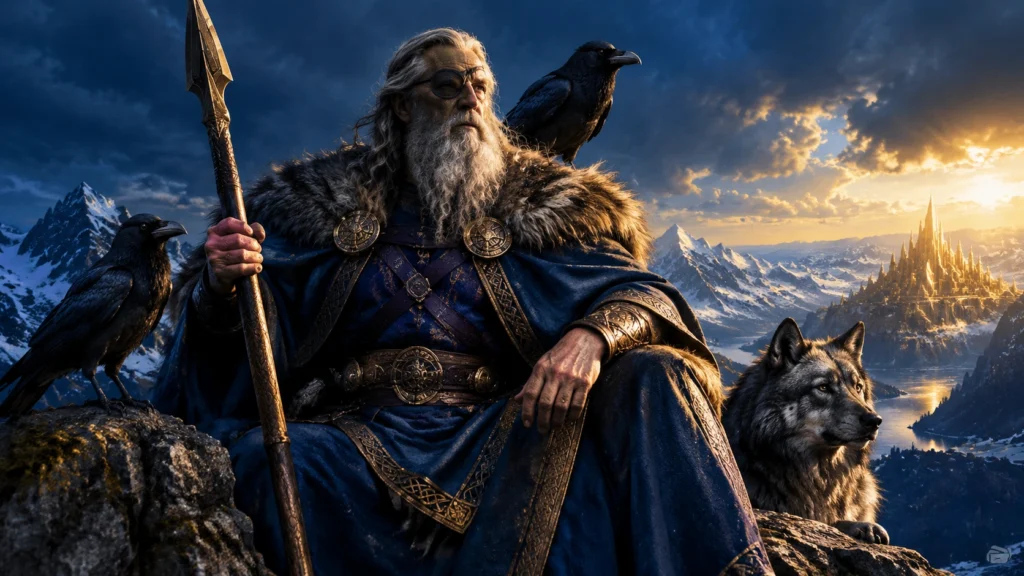
As the leader of the Aesir, Odin presided over Asgard, the realm of the gods, and made decisions that affected the fate of all the Nine Worlds. He sat upon Hliðskjálf, his high seat, from which he could observe everything that happened across the cosmos. His two ravens, Huginn (Thought) and Muninn (Memory), flew out each day to gather information, returning to whisper news into his ears. This constant stream of knowledge informed his leadership and allowed him to anticipate threats before they materialized.
Odin also maintained his position through the practice of choosing warriors for his elite hall, Valhalla. The Valkyries, his chosen battle-maidens, selected the bravest slain warriors from the battlefield and brought them to Valhalla, where they would feast and fight in preparation for Ragnarök, the final battle. This practice reinforced Odin’s dual nature as both a god of wisdom and a god of war, showing that in the Norse worldview, the two were inseparable.
Beyond the One-Eyed Image
Modern depictions of Odin often reduce him to a visually striking figure: a tall, cloaked wanderer with a single eye, a wide-brimmed hat, and two ravens. While these elements are rooted in the sources, they represent only a fraction of his complexity. Odin was a trickster who broke oaths when it served a greater purpose. He was a poet who inspired the creation of verse and song. He was a sorcerer who practiced seiðr, a form of magic associated with women, which drew both admiration and suspicion from the other gods. He was also a figure of deep ambiguity — sometimes generous, sometimes cruel, always unpredictable.
The myths do not present Odin as a purely benevolent deity. He could be ruthless in his pursuit of knowledge, and his willingness to sacrifice others as well as himself sometimes placed him in morally questionable territory. This complexity is part of what makes him such an enduring figure in the study of Norse mythology and early northern history.
Conclusion
Odin Allfather was a god defined by his relentless search for wisdom, his willingness to sacrifice for knowledge, and his multifaceted leadership of the Aesir. His many names reflect the many dimensions of his character, from warrior to wanderer, from poet to prophet. To understand Odin is to move beyond the popular image and engage with the rich, layered mythology that the Norse peoples developed over centuries. His story remains one of the most compelling in the entire tradition of northern European myth and belief.