Loki: Trickster, Father of Monsters, and the Chain That Held Him
Norse mythology tells of gods who shaped worlds, fought giants, and set boundaries for fate. Within that world, Loki stands apart. He is neither fully god nor giant, but a figure who crosses lines, breaks rules, and changes outcomes. He gives the gods clever help and dangerous harm in turns. He is oath-bound to Odin and yet fathers children who become enemies of the gods. His story moves from clever ally to bound prisoner, and it ends with the promise of a final break at Ragnarök.
To follow Loki is to trace a path through loyalty, betrayal, and consequence. He is a trickster in the oldest sense: a mover of boundaries, a tester of order, and a mirror that shows the limits of even divine power.
From outsider to oath-brother
Loki’s parentage marks him as a liminal figure. In many sources he is the son of giants, yet he lives among the Æsir in Asgard. The poems and prose that preserved Norse tradition give different details at times, but the pattern is clear. He is close enough to the gods to join their halls, yet different enough to unsettle them. His quick mind and shape-shifting skill make him useful. His pride and appetite for mischief make him dangerous.
The bond with Odin rests on blood brotherhood. In the poem Lokasenna and in Snorri Sturluson’s Gylfaginning, this oath is named directly. Odin and Loki swear brotherhood, and that sworn tie becomes a key thread in the story. It explains why Loki can sit at the gods’ table, why his betrayals sting, and why the final punishment feels like the collapse of a sacred promise.
The helper who cannot leave trouble alone
Many tales show Loki using his wits to aid the gods. When the gods need to manage threats or win back what they have lost, Loki often devises the plan. He finds solutions where strength alone fails. He bargains, tricks, and shapeshifts to move events forward.
Yet even in those moments, pride and play push him toward harm. He does not stop at solving the problem. He taunts, he prods, and he opens new rifts. The gods benefit from his aid and pay for it at the same time. This is the core of the trickster pattern in Norse mythology: a force that can create and unmake in the same act.
The children of Loki and the shape of doom
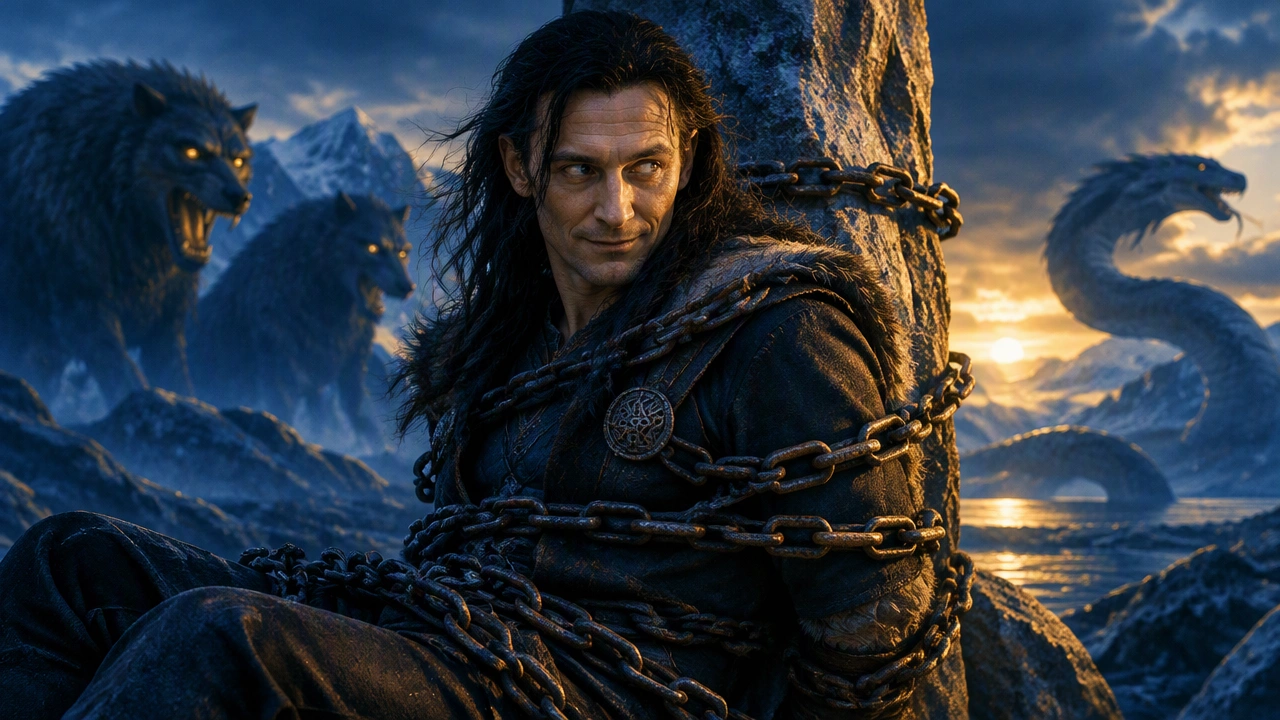
One of the most important threads in Loki’s story is his role as a father. With the giantess Angrboða, he fathers three children who become central to the fate of the gods. These children are Fenrir, Jörmungandr, and Hel. The gods see the threat in them and act to limit their power.
- Fenrir, the great wolf, grows with astonishing speed. The gods try to bind him with chains. The first bindings fail, but the dwarves make Gleipnir, a slender fetter of impossible craft. Fenrir breaks all else but not this band. He bites off Tyr’s hand in the struggle and waits in restraint until Ragnarök.
- Jörmungandr, the World Serpent, is cast into the sea. He grows so large that he encircles the whole world and grasps his own tail. His fate is tied to Thor. At the end, they meet in a final struggle that ends them both.
- Hel is given rule over the dead who did not die in battle. She becomes the cold sovereign of her own realm, a figure tied to fate, not to glory. Her hall, often called Helheim in later telling, receives those who fall by sickness, age, or other ends.
These children are not simply monsters. They are markers of cosmic balance and imbalance. Each holds a place in the web of events that leads to Ragnarök.
The breaking point: Baldr, the oath, and the curse
The death of Baldr is the turning point that turns Loki from nuisance to enemy. Baldr, the bright god, begins to have dreams of death. The gods seek oaths from all things not to harm him. Yet something is missed. Loki finds out what it is and guides blind Höðr to throw the mistletoe that kills Baldr.
The gods’ grief is deep. Their anger is deeper. Loki flees, but he cannot escape the weight of what has happened. He is caught and brought to judgment. The gods bind him in a harsh way that echoes the binding of his own son. They place a serpent above him, and venom drips onto his face. His faithful wife, Sigyn, holds a bowl to catch the poison, but when she must empty it, the venom falls on Loki. His writhing is said to cause earthquakes.
The meaning of the binding
The binding is not only revenge. It is a limit placed on a force that refuses limits. Loki’s cleverness, pride, and hunger for disruption cannot be contained by social ties or sworn brotherhood once those ties have been broken by harm. The gods try to hold the world together by holding Loki down. In doing so, they store up the very energy that will break loose at the end.
This is a strong theme in Norse tradition. Oaths matter. Bonds matter. When they fail, the fallout does not vanish. It waits.
Loki at Ragnarök
In the final age, the bindings fail. Loki breaks free. Fenrir breaks free. Jörmungandr releases his tail and thrashes the sea. Hel sends her hosts. The world that was held together by oaths, craft, and courage faces the unraveling of those same ties.
Loki leads a host against the gods. He meets Heimdallr, and they destroy each other. This last meeting closes the circle that opened with blood brotherhood. The friend of the gods becomes their foe, and both fall.
Why Loki endures in memory
Loki endures because he embodies a truth that early northern culture recognized. Order depends on boundaries, and boundaries attract those who test them. The trickster is not simply a villain. He is the force that reveals the cracks in any system. He helps, he harms, and he shows how close those two acts can be.
His children, Fenrir Jörmungandr Hel, carry that lesson into the structure of fate. They are the signs that the gods’ power has edges. The binding of Loki shows that even sworn kinship can fail when pride and harm grow too great. And the final break at Ragnarök shows that what is bound will, in the end, demand release.
In this way, Loki’s story is not only about one figure. It is about the fragile weave of loyalty, craft, and fate that holds the worlds together, and the long shadow cast by the day that weave gives way.