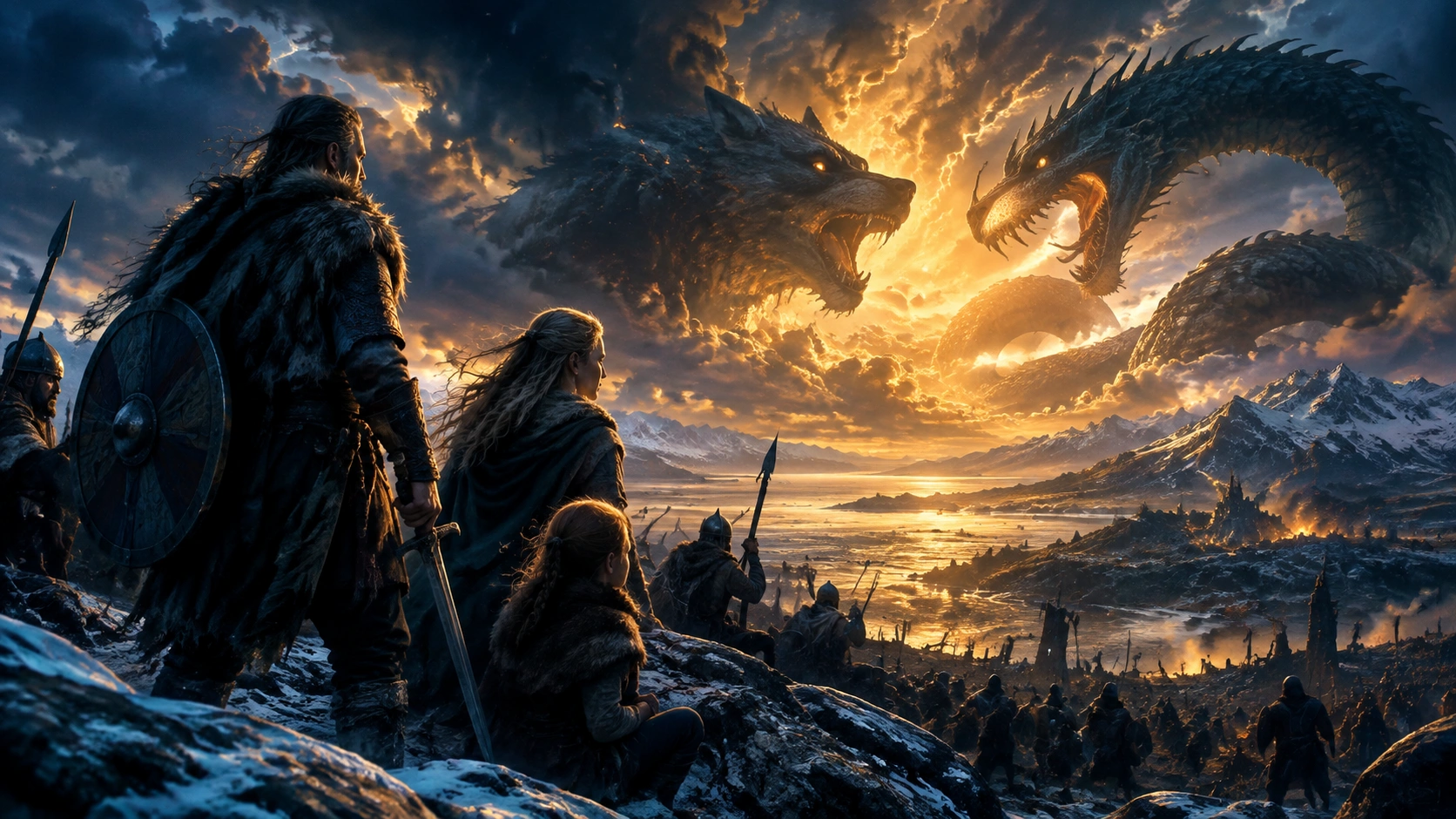
Ragnarok Prophecy, Final Battle, and Survivors Explained
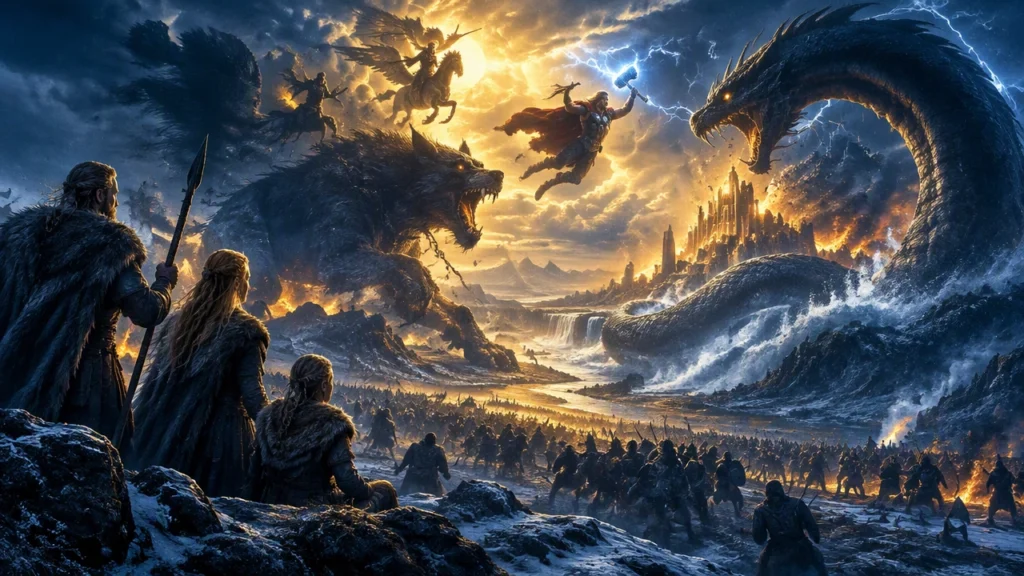
In Norse mythology, Ragnarok is the great cycle of catastrophe that brings the present world to an end. Its name is usually interpreted as “fate of the gods” or “twilight of the gods,” but the stories describe more than a single battle. They present a sequence of warnings, cosmic disruptions, confrontations, deaths, and finally renewal. Understanding the Ragnarok prophecy events and survivors explained here also reveals how early northern peoples imagined order, violence, fate, and the limits of human power.
The Prophecy and Its Warning Signs
The fullest account appears in the Poetic Edda, especially the poem Völuspá, with additional details in Snorri Sturluson’s later Prose Edda. Before the final conflict, the world passes through three successive winters with no intervening summer. This period is called Fimbulwinter. Snow falls from every direction, bonds break, and kin kill one another. These details establish Ragnarok as both a cosmic event and a social collapse.
Other signs involve violations of the natural and moral order. The sun and moon are pursued by wolves, the stars disappear, and a great ship called Naglfar is said to be constructed from the fingernails and toenails of the dead. The world serpent, Jormungandr, rises from the sea, while the giant Hrym steers the ship carrying the giants of Jotunheim. These images join ordinary fears of famine, storm, betrayal, and seafaring danger to a larger mythic pattern.
Before battle begins, the god Heimdall blows his horn, Gjallarhorn, and the gods assemble. Odin consults the head of the wise being Mimir, while the world tree Yggdrasil trembles. The prophecy is not presented as a secret that can be easily avoided. In the Norse understanding, fate is powerful, and even the gods act with the knowledge that their destinies have already been declared.
The Key Battles of Ragnarok
Odin and Fenrir
Odin rides to meet the great wolf Fenrir, who has broken free from the fetter Gleipnir. Odin is swallowed, but his son Vidar immediately avenges him. Vidar forces open the wolf’s jaws and tears them apart. This confrontation places divine knowledge and royal authority against destructive appetite, yet it ends in death rather than simple victory.
Thor and Jormungandr
Thor fights the world serpent after their earlier encounter during Thor’s failed attempt to lift the shape of the giant Utgarda-Loki. Thor kills Jormungandr with his hammer Mjolnir, but he then walks only nine steps before falling dead from the serpent’s venom. The outcome is deliberately balanced: the enemies destroy each other, leaving no triumphant survivor.
Frey, Surtr, and the Fire
The god Frey faces Surtr, the fire giant who rules Muspelheim. Frey lacks his magic sword because he once gave it away to win the giantess Gerdr. He therefore fights without his greatest weapon and falls. Surtr then advances across the world with a blazing sword, and flames engulf both earth and heaven. Fire functions as the final boundary between the old creation and what follows.
Other Divine Confrontations
Tyr, the god associated with law and sworn agreements, fights the hound Garmr and they kill each other. Heimdall and Loki also meet in a fatal struggle. Meanwhile, Loki steers Naglfar while the sons of Muspell sail beside him. The battles are distributed across land, sea, and the divine assembly, suggesting that no part of existence remains untouched.
Survivors and the Renewed World
The question of survival is central to the prophecy. Not every named being escapes. Most of the gods, many giants, the world serpent, Fenrir, and Heimdall die in the conflict. Yet several figures remain hidden in Hoddmimir’s wood, traditionally identified with the sheltered pair Lifthrasir and Life. They survive by feeding on morning dew and are said to populate the earth again. In the Prose Edda, Baldr and his brother Hodr return from the underworld after the destruction. Baldr’s return is especially significant because his earlier death helped set the conditions for the final age.
The earth also rises again from the sea, green and fertile. A new sun, born of the old one, shines with greater brightness. The gods remember their former lives and meet again in the plain called Ida. Some scholars have debated whether these hopeful images are older mythic material or later influences, but within the narratives they provide a clear conclusion: destruction is followed by restoration, not permanent nothingness.
What Ragnarok Meant to the Viking Worldview
Ragnarok did not portray the universe as governed by a final victory of good over evil. The gods fight because their roles demand it, even though they know the outcome. Odin’s pursuit of wisdom, Thor’s defense of order, and the gods’ loyalty to their duties all continue in the face of certain death. This emphasis on acting honorably within an unavoidable fate reflects values found elsewhere in early northern literature.
The myth also helped explain instability. Harsh winters, feuds, shipwrecks, fire, and epidemic disorder could be understood as small reflections of a cosmic pattern. At the same time, the renewed world offered continuity. Kinship lines would continue, the earth would become fertile again, and the essential structures of existence would return in purified form.
Ragnarok is therefore best understood as a prophecy of transformation. Its battles demonstrate the collapse of existing limits, while its survivors show that collapse is not the end of the story. The final image is neither naive optimism nor complete despair. It is a world that has passed through fated destruction and emerged ready to begin again.