Mapping the Nine Worlds around Yggdrasil: Roots, Branches, and the Structure of Norse Mythology
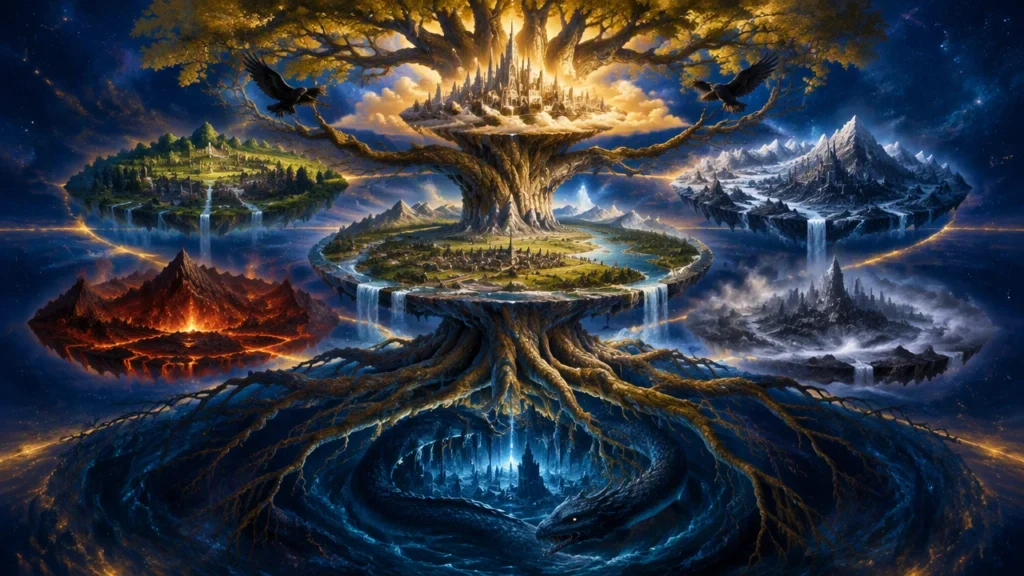
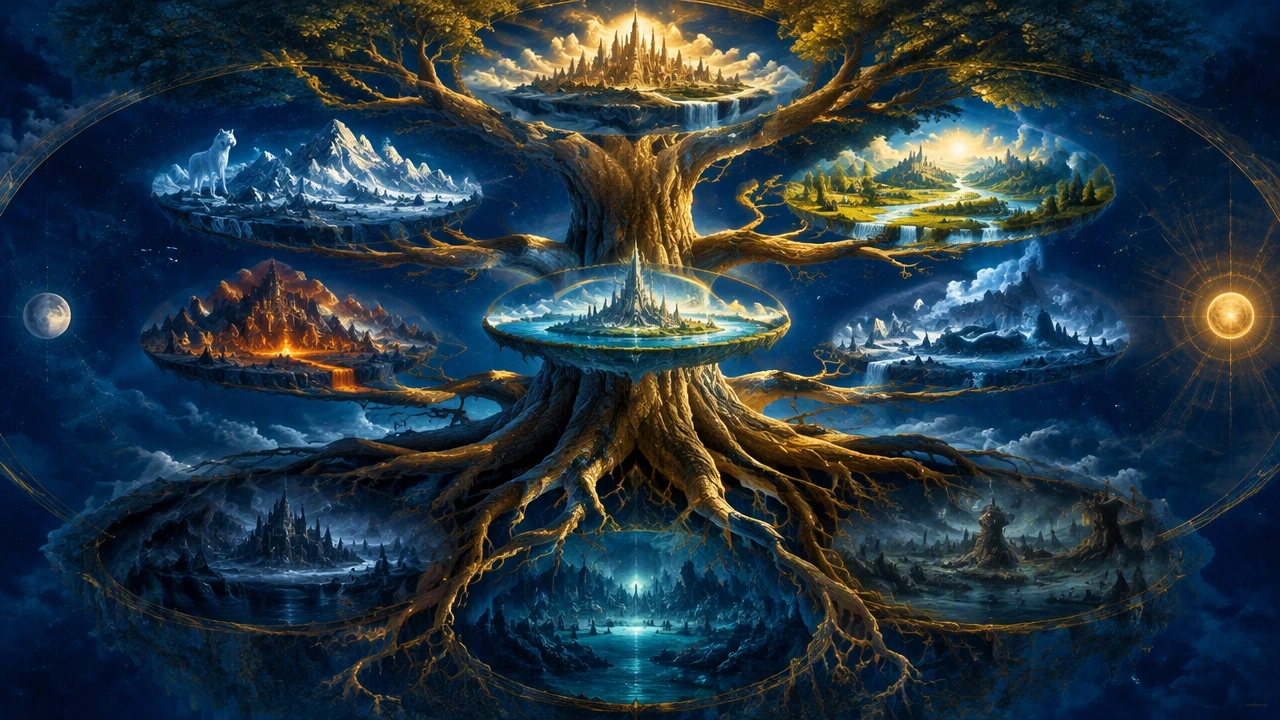
In Norse cosmology, the cosmos is shaped like a vast living structure. At its center stands Yggdrasil, the world-tree, an immense ash or evergreen that holds the Nine Worlds in its boughs and around its roots. This image is not only poetic; it is a practical map. By tracing the three roots, the wells they feed, and the realms that rest on or beside the trunk and branches, we can see how gods, humans, dead, and other beings move through a shared, layered space.
Yggdrasil as the axis of the Nine Worlds
Yggdrasil is the axis mundi, the pillar that aligns the vertical and horizontal dimensions of existence. Its trunk rises through the middle, its three roots reach into different regions, and its branches spread outward and upward. The well-known poem Völuspá and the prose of the Prose Edda describe this structure as a living system that needs care and sustenance. Norns water the tree, animals gnaw at it, and a squirrel runs between realms carrying messages and tensions. That movement shows that the Nine Worlds are not sealed boxes. They are connected by paths that follow the tree’s architecture.
The three roots and the wells that anchor the realms
Three roots anchor Yggdrasil and lead to distinct powers and places.
- Urdarbrunnr (Well of Urd) sits among the gods. Here the Norns shape fate and tend the well with water and white clay. This root ties the tree to order, memory, and the continuity of the divine.
- Mímisbrunnr (Mimir’s Well) is linked with deep knowledge. Odin trades an eye for a drink, gaining insight that guides his rule and his pursuit of wisdom. This root marks a path toward counsel and the hidden meanings of the cosmos.
- Hvergelmir is a roaring spring beneath the tree, guarded by the serpent Níðhöggr. Many rivers flow from it, and it serves as a gateway to the realm of the dead and to cold, remote regions. This root draws attention to decay, renewal, and the forces that test the tree’s endurance.
Together, the wells hold memory, wisdom, and raw elemental energy. Their waters rise around the roots and nourish the tree, while their guardians and residents create lines of travel and conflict that bind the Nine Worlds.
The Nine Worlds and their positions
Old sources do not give a single, rigid floor plan, but they do provide enough detail to map the realms in relation to Yggdrasil’s roots, trunk, and crown. A practical arrangement groups them by level and by the root or branch they are nearest.
Realms of the gods and cosmic order
Asgard is the high realm of the Aesir, placed near the upper part of the tree. It is the seat of councils, oaths, and rituals, and it is connected to other realms by the Bifröst, the rainbow bridge that allows travel under careful watch. Vanaheim, home of the Vanir, is often seen as a neighboring divine realm, tied to fertility, sea, and foresight. The two divine families exchange hostages after their war, which reinforces the idea that the realms are linked by diplomacy and kinship, not only by geography.
Realms of craft, intellect, and elemental skill
Alfheim, the world of the light elves, is associated with brightness and craft. Svartalfheim (or Niðavellir), the domain of dwarves and dark elves, lies underground or within the rock, close to the roots and forges where many of the gods’ great treasures are made. These two realms balance light and depth, showing how skill and material shape the cosmos.
Realms of people and the middle world
Midgard, the human world, is set near the trunk and within the protective circle of the ocean, where the great serpent Jörmungandr lies. It is the middle place in both name and function. Travel between Midgard and Asgard occurs along the bridge or through visionary journeys, while other paths descend toward the dead or remote wilds.
Realms of storm, wilds, and the honored slain
Jotunheim is the land of the giants, a vast wilderness that presses against the boundaries of order. It is not simply an enemy territory; it is a source of raw power, law, and knowledge that the gods both resist and engage with. Vanaheim can also be placed near these wilder regions, depending on the reading, but it remains a divine home. Valhalla is not a separate world but a hall within Asgard, where Odin gathers the honored slain, the einherjar, to prepare for the final battle.
Realms of the dead, cold, and fate
Helheim rests under one of the roots, near Hvergelmir and the cold rivers. It is the realm of those who did not die in battle and is ruled by Hel. The journey to Helheim shows how the tree’s roots lead to a place of quiet and finality, yet also to a kind of continuity. Niflheim, the primordial realm of mist, ice, and cold, is often placed far to the north, near Hvergelmir, and is linked with the origin of many rivers. Muspelheim, the realm of fire, stands at the opposite edge, guarded by the giant Surtr. The meeting of heat and cold at the tree’s base forms the conditions for creation and change.
How the roots and branches connect the worlds
The structure of Yggdrasil explains both movement and balance. The roots draw power upward from wells and springs, while the branches spread that power outward to the realms. The Norns, who tend the well of Urd, represent the ongoing shaping of fate that touches every world. Odin’s quest for wisdom at Mimir’s Well shows how knowledge flows from the roots into the councils of the gods. The serpent Níðhöggr gnawing at the root near Hvergelmir signals constant pressure from decay, which the tree must endure.
The Bifröst links Asgard to Midgard, and the gods travel to meet giants, elves, and dwarves for trade, battle, or learning. The dead move toward Helheim or, if chosen by Odin, to Valhalla. The squirrel Ratatoskr carries insults between eagle and serpent, symbolizing the tension that runs along the trunk. These paths are not random. They follow the tree’s lines: upward toward order and wisdom, downward toward fate and the dead, outward toward wilds and craft.
What this map tells us about Norse thought
The Nine Worlds around Yggdrasil form a living system in which every realm has a role. The gods maintain law and community, the giants test boundaries, the dead hold memory, and the elves and dwarves refine skill and material. The tree itself is a sign that unity does not mean sameness. It holds differences together through roots, trunk, and branches. The wells provide nourishment and knowledge, while the guardians and residents keep the pathways active. This is why the image of the world-tree has such staying power: it explains how a cosmos can be ordered yet dynamic, and how travel, conflict, and exchange can exist within a single frame.
Reading the structure today
To use this map in study or reflection, follow the three roots. Start at Urdarbrunnr for fate and continuity, move to Mímisbrunnr for insight, and descend to Hvergelmir for elemental force and finality. Then trace the trunk upward to Asgard and outward to Midgard, Jotunheim, Alfheim, and Svartalfheim. Notice how each realm connects to the others by well, bridge, road, or river. In that way, the nine worlds around Yggdrasil world tree explained becomes more than a list. It becomes a guide to the paths that shape gods, humans, and the dead in the Norse vision of the cosmos.