Norse Mythology Complete Guide to Gods, Worlds, and Sources
Norse mythology is a body of stories from medieval Scandinavia and the wider Norse cultural world, describing how the cosmos was formed, how gods and other beings interact, and how fate shapes human and divine life. It is not a single book but a web of poems, sagas, and later prose retellings that preserve older beliefs. This guide offers a clear path through its sources, structure, and key figures, so you can see how the whole system fits together.
When people say Norse mythology, they usually mean the myths told by Norse-speaking communities in Denmark, Norway, Sweden, Iceland, and Norse settlements abroad during the Viking Age and the centuries around it. These stories were carried by poets, ritual specialists, and everyday storytellers, then written down mostly in medieval Iceland. They blend cosmology, hero legend, and moral reflection, and they often treat fate, loyalty, and courage as central themes.
Where the stories come from
The main written sources are Old Norse texts preserved in Iceland. The Poetic Edda is a collection of anonymous poems that present gods and heroes in direct, compressed, and often archaic language. Many of these poems are among the oldest witnesses to Norse mythic thought. The Prose Edda, written by the Icelandic scholar Snorri Sturluson around 1220, acts as a handbook for poets and readers. Snorri explains mythic names, gives connected narratives, and frames the old gods as ancient human kings in his euhemeristic introduction, while still preserving the mythic material in detail.
Beyond the Eddas, the sagas of Icelanders and other prose works sometimes reference beliefs, customs, and mythic echoes, even when they are set in a mostly Christian social world. Skaldic poetry, with its dense metaphors and praise formulas, preserves many mythic references and shows how gods and stories were woven into courtly art. Runestones, place-names, and archaeological finds add further context, though they require careful interpretation. Together, these sources create a layered picture rather than a single official version.
How the cosmos is arranged
In the Norse view, the universe is held together by relationships between realms, forces, and beings. Time itself is shaped by cycles and conflicts that will end in a great upheaval and then renewal.
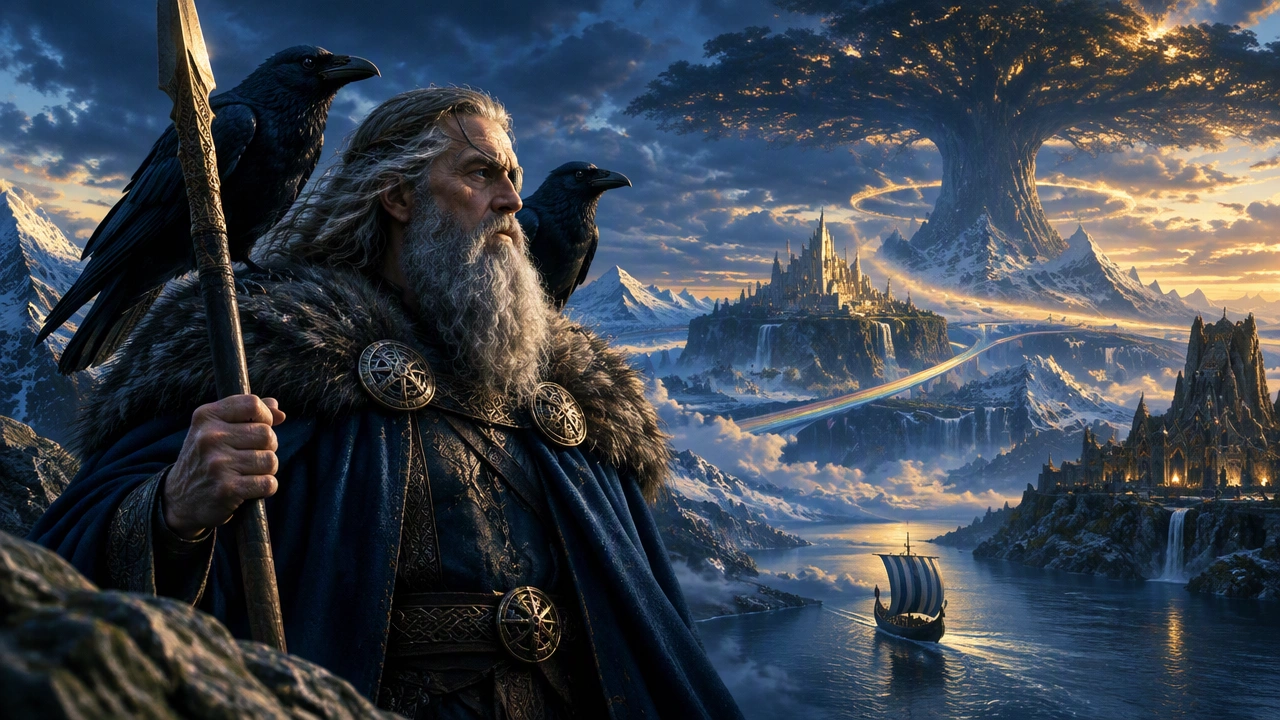
The world is often described as nine realms arranged around or within the structure of the cosmic tree Yggdrasil. These realms include spaces for gods, humans, dead, giants, and other communities. Exact lists vary in the sources, but common realms include Asgard (home of many gods), Midgard (the human world), Jotunheim (land of giants), Vanaheim (home of the Vanir gods), Alfheim (light elves), Svartalfheim or Nidavellir (dwarfs and dark elves), Niflheim (cold mist), Muspelheim (fire), and Hel (realm of the dead under Hel’s rule). The tree is tended by fate-dispensing beings and gnawed by a serpent at its roots, while an eagle sits above, showing how the cosmos is alive and under tension.
Before creation, the sources describe a void called Ginnungagap between the cold of Niflheim and the heat of Muspelheim. From this meeting of opposites, the first beings and conditions for life appear. The giant Ymir is formed, and from Ymir’s body the gods shape the world. This origin story stresses that order is built from struggle and mixture, not from pure peace.
Fate is central. The Norns carve destinies at the well beneath Yggdrasil, and their work influences gods and humans alike. Even the gods live under the shadow of Ragnarok, a foretold series of events in which many gods and giants clash, leading to destruction and then a reborn, greener world. This cycle shows a worldview that accepts both loss and continuity.
The gods and their roles
The gods are divided into two main families: the Aesir and the Vanir. Early conflict between them ends in a truce and exchange of hostages, which signals reconciliation and shared power. Many figures move between these groups, showing that divine identity is flexible.
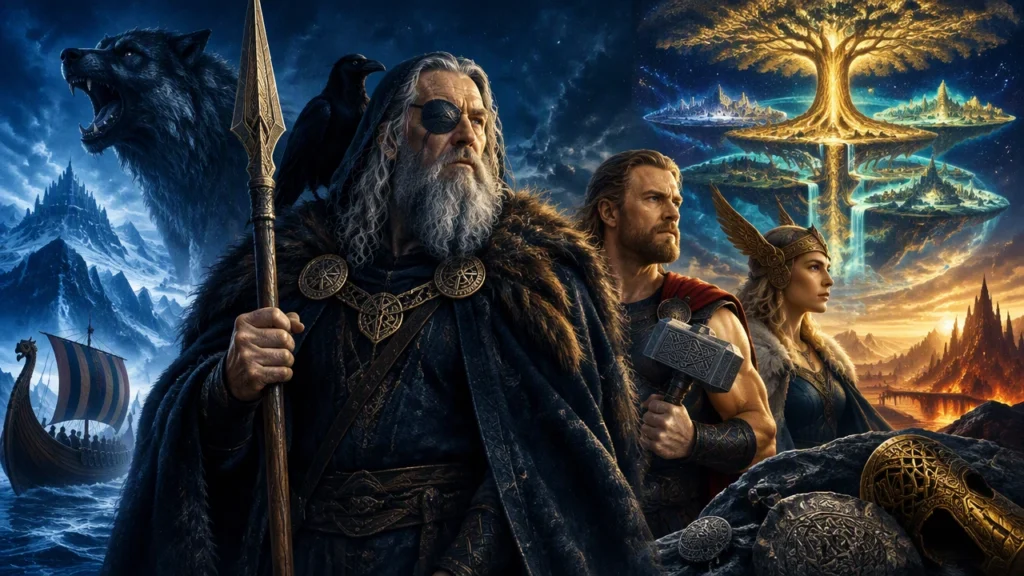
Odin is the god of wisdom, poetry, war, and death. He seeks knowledge through sacrifice, travel, and rune lore, and he gathers warriors in Valhalla. Thor is the defender of order and human communities, known for strength, thunder, and journeys against giants. Frigg is associated with foresight, household, and fate, and she often appears as a queenly presence among the gods. Tyr is linked to law and courageous oath-taking. Baldur is the bright, beloved god whose death becomes a sign of coming crisis. Heimdall watches over the gods and humans and is associated with the Bifrost bridge. Loki is a trickster who can help or harm, and whose actions move the stories toward Ragnarok.
The Vanir include Freyja, a goddess of love, war, and seiðr (a form of magic), and Freyr, a god of fertility, prosperity, and peace. Njord is connected to sea and wealth. Their presence shows how agriculture, trade, and natural abundance are woven into the divine order.
Other beings and forces
Giants, or Jotnar, are not simply enemies but deep forces of nature, time, and chaos. Many are wise, and some are even ancestors of gods. Elves and dwarfs appear as skilled beings linked to beauty, craft, and hidden power. The dead may go to different realms, with Hel receiving many who do not die in battle, while warriors may be chosen for Valhalla or Fólkvangr. Spirits of place, land wights, and ancestors are part of the lived religious world that frames the myths.
Important objects and symbols help explain how power moves. Yggdrasil connects realms and sources of wisdom. Mjölnir, Thor’s hammer, protects gods and humans. Gungnir, Odin’s spear, stands for oath and fate. Draupnir, the golden ring, represents cycles and gift-giving. The binding of the wolf Fenrir and the great serpent Jormungandr show how the gods try to manage threats that will later return at Ragnarok.
Belief, ritual, and society
Norse myths did not exist only as stories. They were part of a culture that valued poetry, memory, and ritual. Offerings at mounds, stones, or groves, seasonal gatherings, and gift exchange linked myth to social life. Names of places and people often carry mythic roots, which means the stories were mapped onto the landscape itself. When Christian scribes recorded the myths, they did so with their own interests, so modern readers must read critically and avoid assuming one single doctrine.
How to read Norse mythology today
Start with the oldest voices: the poems of the Poetic Edda, then use the Prose Edda as a guide to names and connections. Compare different sources and note differences. Look for themes like fate, courage, hospitality, and the tension between order and chaos. Treat the myths as living traditions shaped by history, not as a fixed rulebook.
This complete guide to Norse mythology shows a cosmos built on relation and tension, where gods, giants, humans, and fate meet. Its sources are varied, its worlds are many, and its deities carry both power and limits. By understanding the sources, the structure of the cosmos, and the roles of gods and other beings, you can approach Norse mythology with both respect and clarity.