Norse Mythology: The Aesir vs Vanir War and the Hostage Exchange That Forged a Unified Pantheon
In the earliest chapters of Norse mythology, the gods were not one family but two. The Aesir, associated with war, sovereignty, and cosmic order, dwelled in Asgard. The Vanir, linked to fertility, prosperity, sea-wisdom, and the generative forces of the earth, ruled their own sacred realm. According to tradition, these two divine clans clashed in a devastating conflict before eventually forging a lasting peace through an unprecedented hostage exchange. This story, often called the Aesir vs Vanir war and hostage exchange myth, is one of the most politically and spiritually significant narratives in the entire Norse corpus.
The Roots of the Conflict
The sources that preserve this tale, chiefly the Ynglinga saga by Snorri Sturluson and certain passages in the Völuspá and Gylfaginning, describe the origins of the war in different but complementary ways. In Snorri’s account, the trouble begins with a figure named Gullveig, a woman of the Vanir who arrived among the Aesir carrying gold and a mysterious, intoxicating power. The Aesir, suspicious of her influence, seized her and thrust her into the fires of a hall three times. Each time she burned, she was reborn. This act of violence against a Vanir emissary ignited a full-scale divine war.
Other scholars and commentators have noted that the conflict may also reflect deeper tensions between two conceptions of power. The Aesir represented martial authority and hierarchical rule. The Vanir embodied the cyclical abundance of nature, trade, and seiðr, a form of sorcery associated with foresight and the shaping of fate. These were not merely different pantheons but different philosophies of how the world should be governed.
The War Itself
The Aesir and Vanir fought with tremendous force. The Aesir, led by Odin, constructed the great walls of Asgard and marshalled their warriors. The Vanir, commanded by figures such as Njörðr and his children Freyr and Freyja, countered with their own formidable powers. The war raged back and forth, and both sides suffered losses. Neither could claim a decisive victory.
This stalemate is one of the most important details of the narrative. In many mythological traditions, wars between gods end with one side triumphing outright. Here, however, the story insists on a different outcome: mutual exhaustion leading to negotiation. The implication is that neither force of arms nor force of nature could dominate the other. Both were essential to the health of the cosmos.
The Peace Negotiations and Hostage Exchange
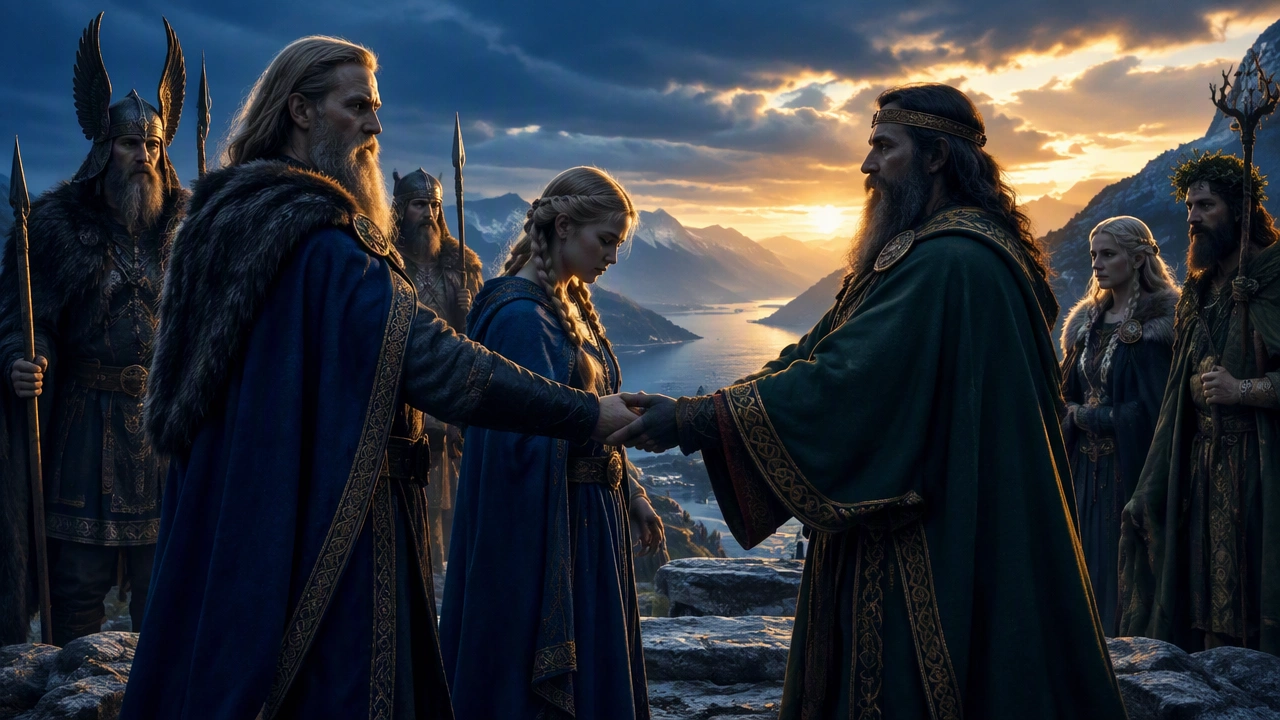
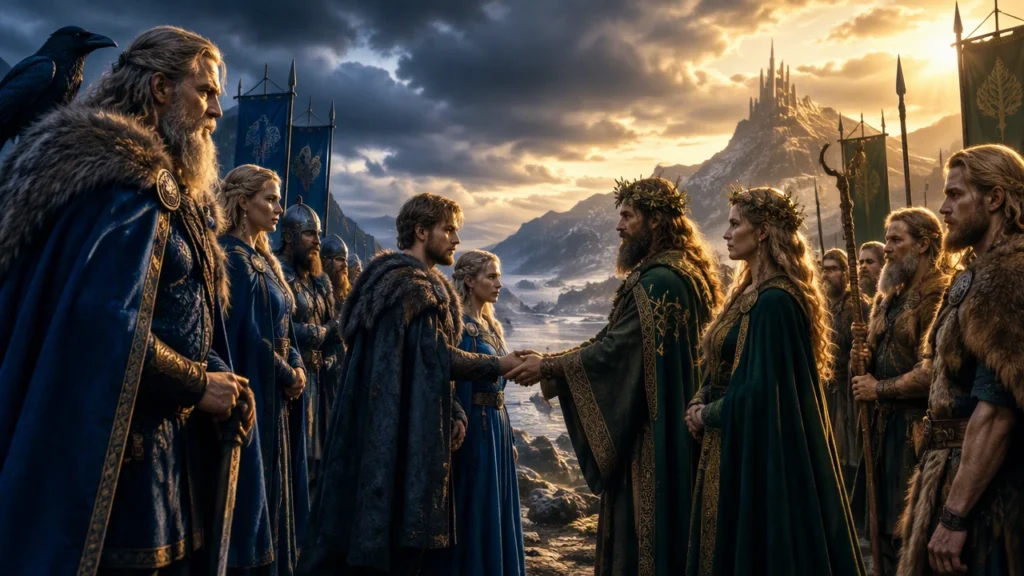
After prolonged fighting, the two clans agreed to meet and forge a truce. To seal the peace, they performed a ritual exchange of hostages. The Vanir sent Njörðr, Freyr, and Freyja to live among the Aesir in Asgard. In return, the Aesir sent Hœnir, a tall and seemingly noble god, and Mímir, the keeper of the well of wisdom and Odin’s trusted counselor, to dwell with the Vanir.
This arrangement was meant to guarantee good faith. If either side broke the treaty, the hostages could be harmed. The exchange also ensured that each clan gained knowledge and power from the other. Freyr became a great king among the Aesir, associated with peace, sunshine, and bountiful harvests. Freyja took her place as the foremost goddess of love, desire, and seiðr magic, teaching the Aesir arts they had not previously practiced. Njörðr presided over the sea and wealth. From the Aesir side, Mímir brought profound wisdom to the Vanir, though his tenure ended tragically when the Vanir, perhaps suspicious of his knowledge or feeling slighted by his counsel, beheaded him. Odin later preserved Mímir’s head with herbs and spells so that it could still speak, a detail that underscores how even the peace process was fraught with tension.
The Significance of the Unified Pantheon
The merger of the Aesir and Vanir created a single, blended pantheon that reflected the complexity of Norse religious life. Real-world Scandinavian communities depended on both warfare and agriculture, both political authority and fertile land, both martial courage and the mysterious power of seiðr. By uniting the two divine families, the myth provided a theological explanation for why all these forces were worshipped together.
The story also carries a striking political message. Even gods, the most powerful beings in the cosmos, could not solve every problem through violence. Peace required compromise, trust, and the willingness to share what was most precious. The hostage exchange was not a sign of weakness but a sophisticated act of diplomacy that preserved both clans and enriched both traditions.
What the Myth Tells Us About Norse Society
Many scholars have observed that the Aesir-Vanir conflict may mirror historical processes in early northern Europe. The pre-Christian societies of Scandinavia likely incorporated multiple religious traditions over time. As different communities merged through trade, migration, or conquest, their deities and rituals blended as well. The myth of the war and hostage exchange could be a mythologized memory of that long, complex process of cultural integration.
The presence of seiðr in the Vanir tradition is particularly telling. In Old Norse society, seiðr was considered powerful but socially ambiguous, sometimes associated with ergi, a concept of unmanliness. Odin himself practiced seiðr despite this stigma, suggesting that the Aesir absorbed Vanir practices even when those practices challenged existing norms. The unified pantheon was not a neat, harmonious fusion but a living negotiation between different values.
Legacy in Later Sources
The Aesir vs Vanir war and hostage exchange myth reverberates throughout the later mythological texts. Freyr and Freyja become two of the most prominent gods in worship and literature. Njörðr’s association with seafaring and prosperity made him central to the lives of traders and fishermen. Even the figure of Mímir, with his preserved head offering counsel to Odin, became a lasting symbol of wisdom that survives violence and loss.
The war also sets a precedent for the final catastrophe of Ragnarök. If the gods could not fully control the forces of the cosmos even after unification, their eventual defeat at the end of the world becomes all the more poignant. The peace between Aesir and Vanir was real and productive, but it was not permanent or absolute, much like peace in the human world.
Conclusion
The story of the Aesir-Vanir war and its resolution through hostage exchange is far more than an ancient battle narrative. It is a meditation on the nature of power, the necessity of compromise, and the richness that comes when different traditions meet and learn from one another. By understanding this myth, readers gain insight not only into Norse mythology but into the values and historical experiences of the early northern peoples who told and retold it for generations.