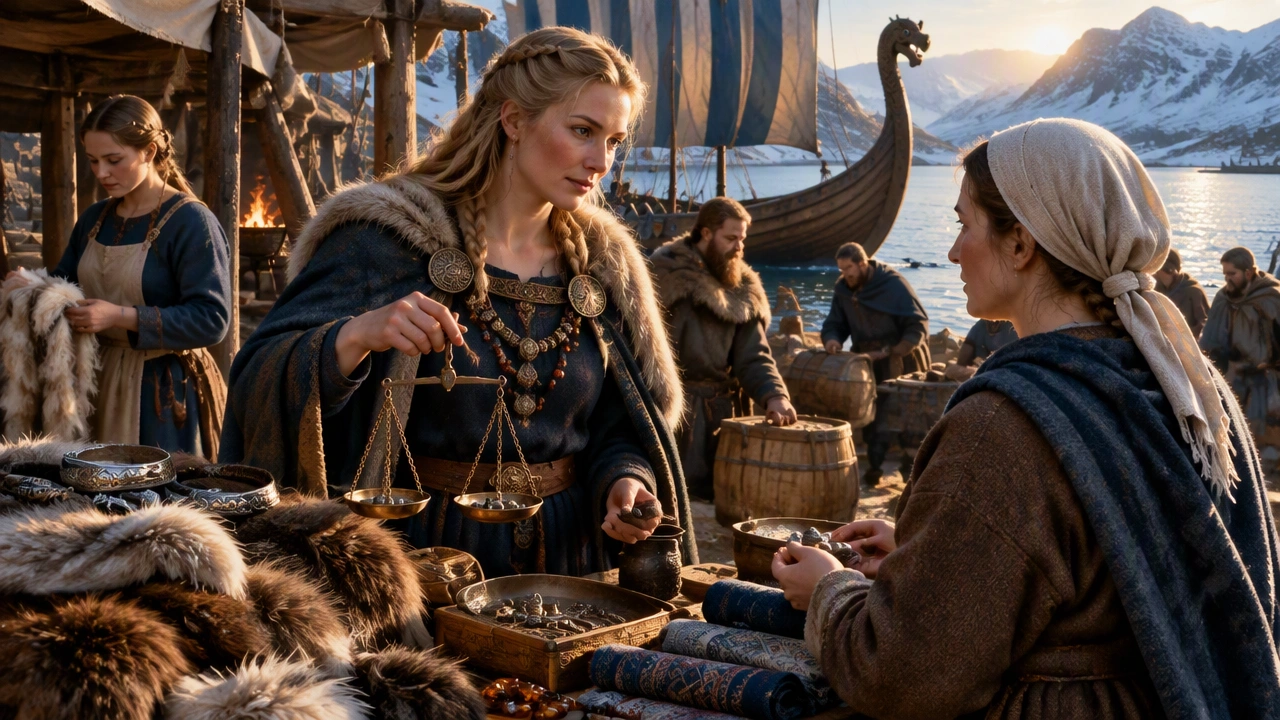
Women in Viking Age Society: Rights, Household Authority, and Trade
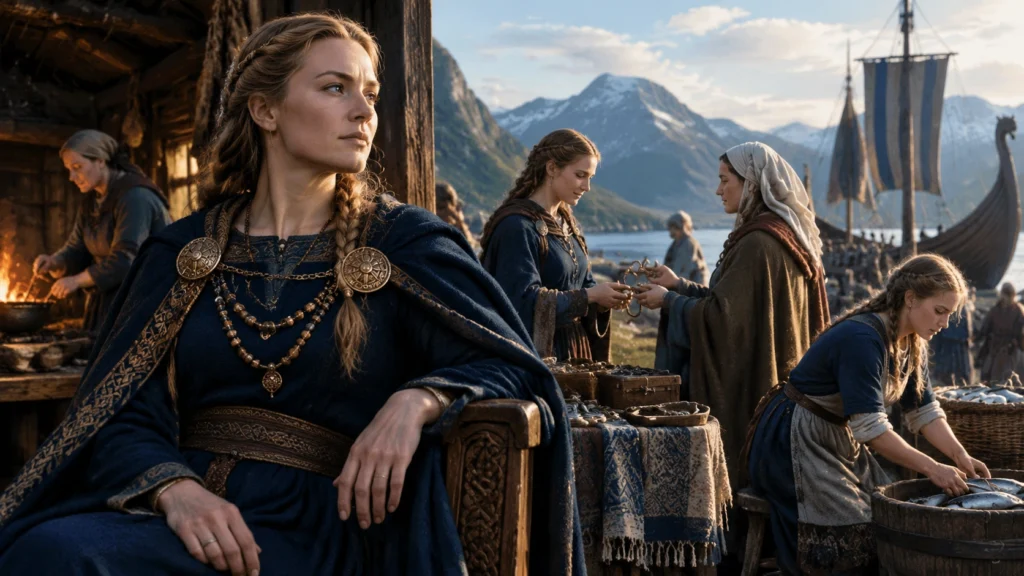
Images of the Viking Age often center on raiders, ships, and saga heroes, yet the period’s legal and household records reveal a more varied social world. Norse mythology supplies memorable figures such as the all-knowing Frigg and the fierce Valkyries, but historical evidence comes from law codes, sagas, runestones, burials, and archaeology. Together, these sources help us examine the legal rights, household authority, and possible trading lives of women in Scandinavia and the wider Norse world.
Legal Standing in a Male-Led Society
Early northern law was not uniform. Rules differed by region and period, and surviving texts were often written down after centuries of oral use. Even so, several recurring features suggest that free women could hold recognized legal positions. Women could own property, receive inheritance, and bring disputes before an assembly in some settings. A woman’s standing often depended on her marital status, the support of male kin, and whether she was free or enslaved.
Marriage created obligations for both spouses, but it also gave women a defined place within the household and the wider community. A wife could manage resources while her husband was away, and a widow could sometimes control property in her own name. The famous Icelandic figure Auðr inn djúpúðga, or Aud the Deep-Minded, appears in later saga tradition as a widow who organized a sea voyage and distributed land to her followers. Whether or not every detail is historical, the story reflects a cultural memory of women exercising authority over movement, resources, and settlement.
Household Authority and Economic Responsibility
The household was the basic unit of production and survival. Women supervised food storage, textile work, animal care, and the distribution of supplies. Textile production was especially important: wool and cloth were valuable goods, and skilled work could contribute directly to a family’s wealth. In a society where long journeys and seasonal work could remove men from home for extended periods, the woman who managed a farmstead held practical power over labor, budgets, and daily decisions.
Household authority did not mean equal authority in every sphere. Men dominated many public offices, legal proceedings, and armed activities. Yet the boundary between domestic and public life was porous. A woman who controlled land, tools, or trade goods could influence negotiations, hospitality, and alliances. Saga literature often shows women steering conversations, refusing unwanted marriages, or urging action. Such scenes are literary, not courtroom transcripts, but they point to a society that recognized female speech and judgment as socially consequential.
Women as Traders and Travelers
Did women take part in Viking trade and travel? The evidence is mixed but not empty. Archaeological finds show that women were buried with goods associated with long-distance exchange, including fine beads, silver, and imported objects. In some graves, tools linked to textile work appear alongside items that may signal household management. These combinations do not prove that every woman was a merchant, but they do suggest that women could control valuable materials and participate in networks of exchange.
Runestones and saga narratives add another layer. Some inscriptions commemorate women who inherited property or managed estates after a husband’s death. Saga accounts describe women sailing to new settlements, founding households, and negotiating with neighbors. The historical reliability of individual stories varies, but the repeated appearance of active women in the narrative tradition suggests that female movement and economic agency were not unimaginable to medieval northern audiences.
Trade in the Viking Age was often a household enterprise rather than an individual career. A family might combine farming, craft production, transport, and small-scale exchange. Women could contribute by producing goods, supervising stores, hosting travelers, or handling transactions when men were absent. This does not mean that women routinely sailed on every trading voyage. It means that commercial life depended on coordinated work within households, and that women’s labor could be central to the value chain even when their names never reached the record.
Travel, Risk, and Social Limits
Travel was dangerous and socially regulated. Rivers, ports, and market towns brought opportunity, but they also exposed travelers to theft, conflict, and enslavement. Women’s mobility was shaped by kinship protection, marital status, and legal custom. A woman traveling with family, a sponsor, or a recognized household had a stronger claim to safety and hospitality than an unattached stranger. Enslaved people, by contrast, had severely restricted rights, and their experiences must not be confused with those of free women.
Archaeology can sometimes identify sex in burials, but interpretation remains difficult. Grave goods do not map neatly onto modern job titles. A sword is not proof of combat experience, and a set of keys does not automatically mean that a woman was a merchant. The most responsible conclusion is that women’s roles and rights in Viking Age society were varied, regionally specific, and shaped by both law and practical necessity.
What the Sources Actually Show
The strongest evidence supports several cautious points. Free women could own and inherit property in many northern communities. Widows could exercise substantial household authority. Women’s work in textiles, food production, and estate management was economically important. Some women controlled valuable goods, moved between settlements, and participated in the social networks that made trade possible. At the same time, the sources do not show a fully egalitarian society, and they rarely preserve the names of ordinary women traders.
Norse mythology can illuminate cultural ideals, but it cannot replace historical evidence. Figures such as Frigg, Freyja, and the Valkyries express themes of knowledge, desire, fate, and martial power. Their stories helped shape how people imagined gender and authority, yet legal rights belonged to real communities with local customs and changing conditions. Separating myth from record allows us to appreciate both the symbolic force of the stories and the more grounded, complicated lives described by laws, archaeology, and narrative texts.
In the end, the Viking Age was neither a simple story of female freedom nor one of total exclusion. Women exercised authority within households, held property under certain conditions, and contributed to the economic networks that connected farms, markets, and distant shores. Their lives were constrained by hierarchy and risk, but the surviving evidence still reveals agency, responsibility, and a public presence that deserves careful attention.