Valkyries, Choosers of the Slain: Names, Roles, and Appearances in Eddic Poetry
In Norse mythology, Valkyries stand between battle and fate, yet their image often drifts into modern fantasy. The clearest way to understand them is to return to Eddic poetry and to ask directly what were Valkyries, choosers of the slain, role within those texts. The answer is more precise and less romantic than many expect.
Valkyries appear in the Poetic Edda and in Snorri Sturluson’s Prose Edda, works compiled in medieval Iceland but drawing on older skaldic tradition. In these sources they are not simply warrior maidens. They serve Odin, move over battlefields, and shape the moment when a fighter falls. Their function is tied to selection, attendance, and the transfer of chosen warriors to the afterlife.
What the Eddas say about Valkyries
The Poetic Edda presents Valkyries in several poems, including Hávamál, Grímnismál, and the Helgakviða poems. In Hávamál, Odin says that he gave a drink to the Einherjar, the battle-chosen dead, and that Valkyries carry ale to the hall of the slain. In Grímnismál, the speaker names a number of Valkyries who serve in Valhöll and pour drink for the Einherjar. In the Helgakviða poems, Valkyries ride to battle, choose who will die, and later meet heroes as luminous figures who speak of fate and reward.
Snorri’s Prose Edda offers a systematic summary. He defines Valkyries as maidens sent by Odin to every battle, states that they choose the slain, and adds that they also give victory. Snorri also links some Valkyries to the service of food and drink in Valhöll, and he names several of them. This picture is consistent with the poetic sources: Valkyries are agents of Odin, active in war and in the hall of the dead.
Names and what they suggest
Eddic and skaldic texts list many Valkyrie names, and the names often reflect function or imagery. Common examples include Skögul, Gunnr, Hildr, Göndul, and Röskva. Some names point to battle: Gunnr and Hildr mean war and battle. Others suggest exaltation or power: Skögul can be read as high or exalting, and Göndul as wand-bearer or staff-bearer, an image linked to command or ritual presence.
The Helgakviða poems name Sigrún and other Valkyries, and they show Valkyries choosing a hero, granting him protection, and later receiving him after death. In the Prose Edda, Snorri lists Valkyries who serve in Valhöll and also notes that some are of divine origin while others are human women who receive the title for their role. The list is not fixed, and different poems add different names, but the pattern is stable: Valkyries are named agents who act for Odin.
Appearances in the poems
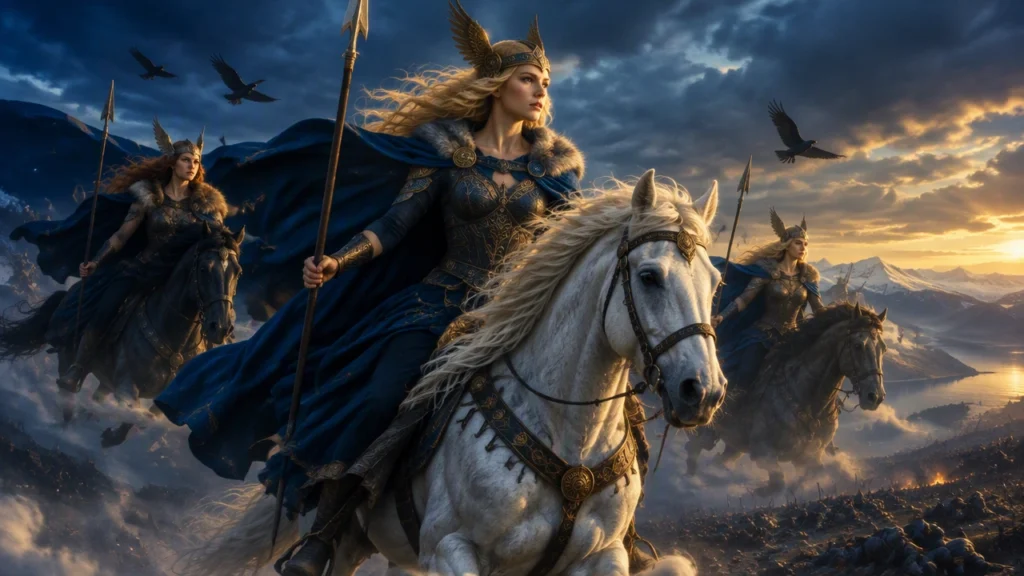
Eddic poetry describes Valkyries with a few strong images. They ride over battlefields, often on horseback, and sometimes with wolves and ravens nearby. They decide the turn of combat and call out to heroes. In Helgakviða Hundingsbana, a Valkyrie sits armed on a horse, shines when night falls, and speaks of choosing the hero and of a future life in the hall of the slain.
The poems do not present them as a uniform chorus. Some scenes show a single Valkyrie who meets a hero and names his fate. Other scenes show a group pouring drink for the Einherjar. The emphasis is on action and role rather than on elaborate costume or fixed symbols. Later sagas and some skaldic verses add details, but the Eddic core is direct: Valkyries choose, attend, and speak with the chosen.
Choosers of the slain: what the role means
The phrase choosers of the slain names a specific function. Valkyries select who falls in battle and, by extension, who joins the Einherjar. This selection is not random. In the poems it is tied to Odin’s will and to the fate spoken over heroes. In Helgakviða Hundingsbana, the Valkyrie says that she was sent to choose among the sons of kings and that she would have given the hero victory if he had been fated to live.
The role has two sides. On the battlefield, Valkyries bring about the moment of death for the chosen. In the hall, they serve drink and receive the dead. This combination links combat to communal life after death, a key idea in Norse thought about warriors and honor. The Valkyrie is both messenger and host, a figure who binds the field to the hall.
Valkyries and the Einherjar
The Einherjar are the warriors chosen for Valhöll. The poems and Snorri describe them as Odin’s guests who fight and feast until Ragnarök. Valkyries play a direct role in this cycle. They choose the slain, bring them to the hall, and serve them there. In Grímnismál, Valkyries are named as those who pour ale for the Einherjar. In Hávamál, Odin speaks of drink given to the Einherjar, and the Valkyries’ service is part of that scene.
This relationship clarifies why Valkyries matter beyond the battlefield. They are not only figures of war. They are part of the structure of reward and community among the dead, a structure that gives meaning to courage and to the choice made in battle.
Divine maidens or human women
Eddic sources present Valkyries both as divine figures and as women who receive the title through their role. Some poems describe Valkyries as Odin’s servants with power over fate. Others mention women called Valkyries in a more human context, such as in the Helgakviða poems where Sigrún is both a Valkyrie and a figure with personal ties and grief.
Snorri notes that some Valkyries are of the gods while others are human women who are given the name because of their task. This double use explains why Valkyries appear in both mythic and heroic settings. The core idea remains the same: the role is defined by choosing and attending the slain, not by a single origin.
Common modern images versus Eddic evidence
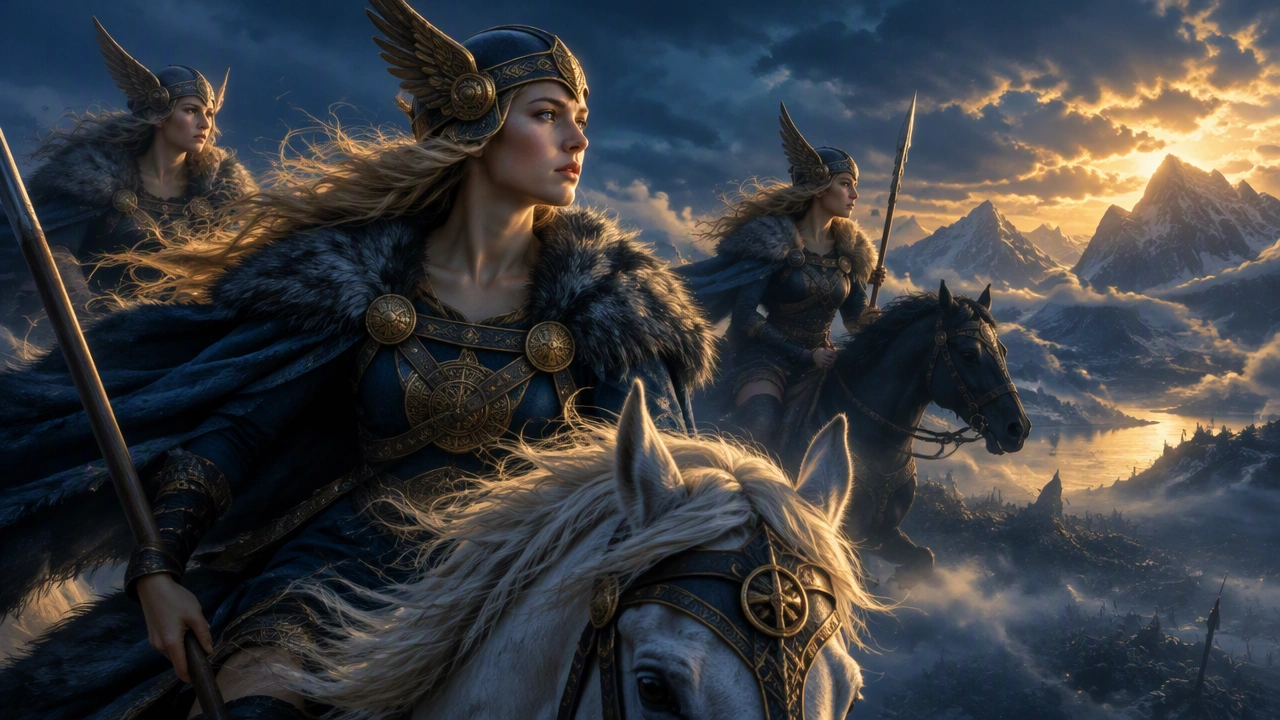
Modern fantasy often shows Valkyries as armored angels of death with large wings, gleaming breastplates, and dramatic banners. The Eddic evidence is more restrained. The poems do not describe wings. They focus on riding, shining light, speaking fate, and serving drink. Armor appears, but the emphasis is on presence, choice, and action rather than on a fixed costume.
Another modern image is the Valkyrie as an independent warrior who fights alongside heroes. In the Eddas, Valkyries do influence battle, but they act under Odin’s command and their main task is selection and service. They are not presented as freelance fighters. Their power is real, but it is tied to their role.
Why the Eddas matter for understanding Valkyries
The Eddas give the most reliable outline of Valkyrie function in early northern belief. They show Valkyries as agents of Odin, choosers of the slain, and attendants in the hall of the dead. They name specific Valkyries and link their names to battle, exaltation, and command. They describe scenes of meeting, selection, and reward. This is the foundation for any serious answer to what were Valkyries, choosers of the slain, role.
By returning to these sources, we separate myth from modern fantasy. The result is a clearer view of Valkyries as figures who bind fate, battle, and community in Norse thought. Their names and actions in Eddic poetry give a precise picture: they choose the fallen, they serve the chosen, and they speak the promise of honor after death.