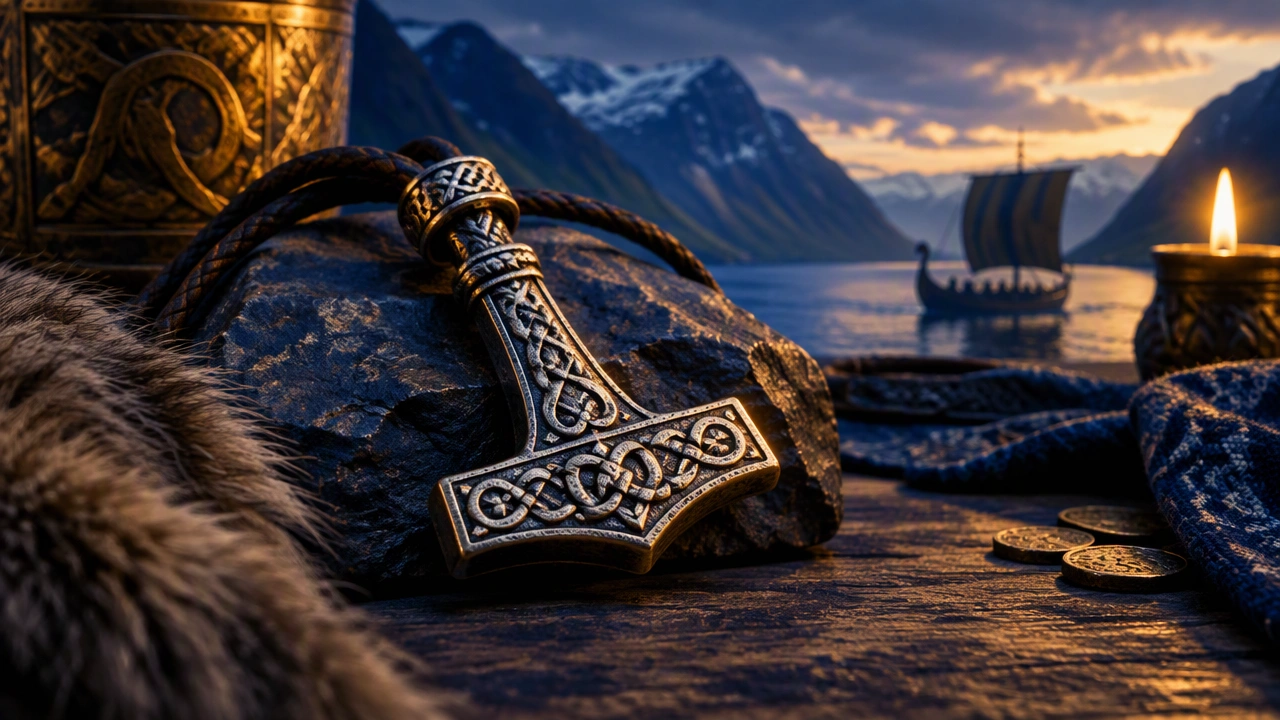
Tracing Thor’s Hammer: Mjolnir as Amulet and Belief in the Early North
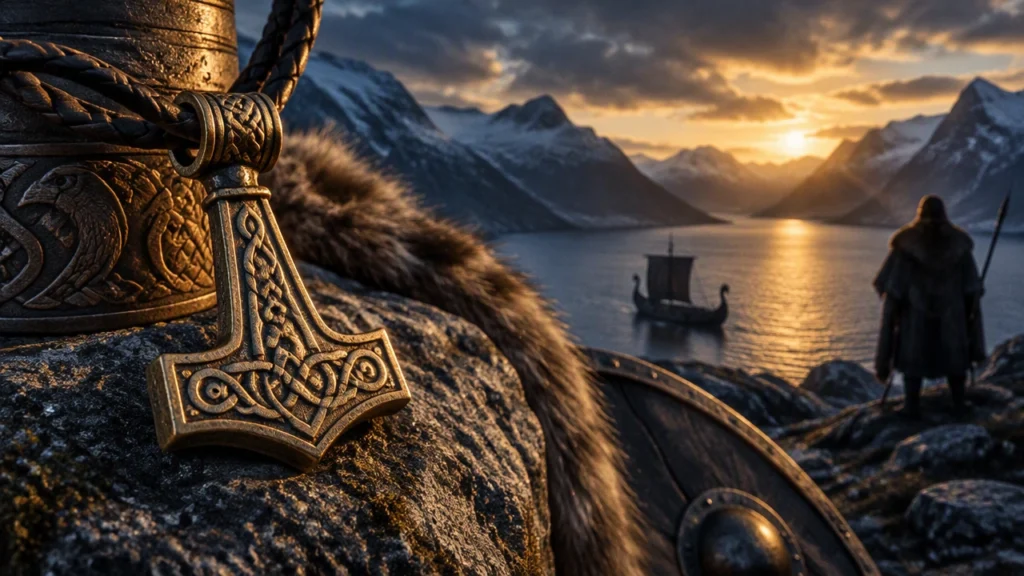
Across the early northern world, few symbols carry the staying power of Thor’s hammer, Mjolnir. In Norse mythology and in the lived world of the Viking Age, the hammer stood for strength, protection, and the defense of the community. Archaeology shows that this was not only a literary motif. People wore small hammer pendants, placed them in graves, and used them in rituals. Studying these objects helps us see how a mythic weapon became a portable sign of faith and a practical charm against harm.
The meaning of Thor hammer Mjolnir pendant symbolism is not a single idea. It weaves together protection, blessing, identity, and craft. Thor was the defender of gods and humans, the guardian of order against chaos. His hammer, forged in the depths of the earth by skilled dwarfs, could crush giants and return to his hand like a boomerang. In human life, that story translated into everyday needs: safe journeys, strong homes, fertile land, and defense from hostile forces. A small hammer worn around the neck brought those hopes close to the body.
What Mjolnir Meant in Myth and Society
Thor occupied a central place in the religious life of many Scandinavian and North Atlantic communities. While Odin was tied to rulers, poets, and warriors seeking glory, Thor stood for the wider household and the working world. Farmers, sailors, and families turned to him for protection and stability. His hammer, Mjolnir, expressed that role. It was a tool that built and a weapon that guarded. In myth, Thor uses it to keep giants at bay and to hallow people and places. That dual function—construction and defense—made the hammer a flexible symbol in real life.
Early medieval writers describe rituals in which Thor’s hammer was used to bless unions, mark new spaces, and sanctify objects. While these accounts come from authors with their own viewpoints, they match the pattern we see in objects and burial customs. The hammer appears where people want to show loyalty to Thor, claim his protection, or mark a rite of passage.
Archaeological Finds: Where Hammer Pendants Appear
Archaeologists have recovered Mjolnir pendants from many sites across Scandinavia, the North Atlantic islands, and areas of contact with other cultures. They are found in town layers, rural farmsteads, ship burials, and simple graves. Most date to the Viking Age, roughly the ninth to eleventh centuries, but related forms continue into the early Christian period. The distribution shows a shared symbol used by different communities, from coastal trading hubs to inland settlements.
Notable finds include hammer pendants from sites in Sweden and Norway, as well as from Iceland, Greenland, and the Faroes. Some are tiny and plain, cast in bronze or lead. Others are elaborate, with fine filigree, silver inlay, or decorative heads shaped like Thor’s face. A well-known example from Købelev on the Danish island of Lolland stands out because it bears a runic inscription that names Thor, making the dedication explicit. Such inscriptions are rare, but they help confirm that these objects were not just generic charms. They were meant to invoke Thor by name.
Burial contexts add more detail. Hammer pendants appear with women’s jewelry sets, with children’s graves, and with male burials that include weapons or tools. This wide spread suggests that Mjolnir was not limited to one gender or status. It served as a protective emblem for travelers, a marker of household identity, and a symbol of community belief.
Design, Materials, and Craft
Most Mjolnir pendants are small, often between two and five centimeters long. They echo the shape of a hammer with a short handle and a broad head. Some have a perforated loop at the top for a cord or chain. Others use a hidden channel inside the head to attach the suspension, keeping the outline clean. Makers used bronze, silver, iron, and occasionally gold. Simple cast pieces could be produced quickly for wider use, while fine examples show skilled metalwork and careful finishing.
The choice of material and style often signals status and access. A plain bronze hammer might serve a farmer’s family as an affordable charm. A silver piece with filigree or niello work speaks to wealth and connections. In some regions, Mjolnir pendants sit alongside Christian cross pendants in the archaeological record. A few remarkable objects combine both motifs in one piece, suggesting that people navigated changing religious landscapes with layered symbols rather than sharp breaks.
Ritual Use and Protective Practice
Beyond wearing Mjolnir, people may have used it in specific moments. The shape itself could bless or seal an act. Hammers placed in graves likely guarded the dead and marked their identity. In household contexts, a pendant could be touched during oaths or lifted during toasts to Thor. While direct evidence for gestures is hard to capture, the pattern of finds supports a wide range of protective uses.
Thor’s role as a guardian of boundaries and thresholds gives extra meaning to pendants found near doorways, hearths, and storage areas. These are the spaces that needed safeguarding. In a world where fire, disease, and sea travel posed constant risks, a portable symbol of divine strength offered reassurance.
From Myth to Material Life
The journey of Mjolnir from epic tale to worn object shows how myth enters daily routine. A story about a divine hammer becomes a small amulet shaped by a craftsperson, purchased at a market, and given as a gift. That move from tale to thing does not reduce the symbol. It makes it personal. People carry their hopes and loyalties with them, literally and visually.
The hammer also signals belonging. In communities spread across the North Atlantic, a Mjolnir pendant could mark shared values and a common story. It could show respect for Thor’s power and a commitment to the protection of kin and neighbors. When paired with other symbols, such as Thor’s hammer alongside a cross, it can also show negotiation and adaptation in times of change.
Reading the Evidence with Care
Archaeology offers objects, layers, and patterns, while texts offer names, stories, and interpretations. Combining them helps us understand Mjolnir, but it also asks for caution. Not every hammer-shaped pendant carries the same meaning. Context matters: where it was found, who it was buried with, and what else was near it. The safest reading is a broad one. Mjolnir pendants express protection, blessing, and loyalty to Thor, with local variations in style and use.
The strongest picture comes from the convergence of sources. Literary references to Thor’s hammer as a hallowing tool match the wide distribution of pendants. Inscribed examples name Thor directly. Burial and settlement finds place the symbol where people lived, worked, and traveled. Together, these lines of evidence show that Mjolnir was both a protective amulet and a sign of faith, grounded in the daily needs of early northern societies.
Key Takeaways
- Protection and blessing were the central roles of Mjolnir pendants, reflecting Thor’s place as defender of people and order.
- Archaeological finds across Scandinavia and the North Atlantic show wide use by different groups and genders.
- Materials and design range from simple charms to fine silver work, signaling status and access.
- Ritual contexts, including burials and household spaces, point to both personal and communal uses.
- Layered symbols, such as hammer and cross together, suggest adaptation during religious change.
By tracing Mjolnir from myth to metal, we see a symbol that carried people’s hopes for safety, strength, and community. That is the core of the meaning of Thor hammer Mjolnir pendant symbolism: a divine tool brought down to earth, shaped by hands, and worn to meet the risks and choices of everyday life.